Switzerland · Bernese Oberland
Interlaken: Baby-Friendly Mountains, Lakes & Waterfalls
Unpack once, day-trip to the Alps' most iconic lakes and waterfalls with a baby in tow.
We wanted the signature Swiss alpine experience without the classic mistakes families make on a short trip: too many bases, too much altitude, too much transit. So this is a single-base plan built around Interlaken, in the heart of the Bernese Oberland. We fly into Zurich, take the train straight to one hotel, unpack once, and use Switzerland's barrier-free rail, boats, and funiculars to reach the postcards each day. It protects the baby's nap routine, removes the car-seat question entirely, and still delivers Lake Brienz, Lake Thun, Lauterbrunnen's valley of waterfalls, Wengen's car-free mountain village, and Harder Kulm's two-lake viewpoint, all in a very concentrated radius.
The trip is mid-range in budget and lowest-stress in style. From a single base in Interlaken Ost, Unterseen, or Wilderswil we run easy modular day trips: Lauterbrunnen + Staubbach Falls + Wengen, a Lake Brienz cruise to Giessbach Falls, and a 10-minute funicular up Harder Kulm followed by the gentle Lake Thun / Spiez side. Lauterbrunnen alone gives the classic 'Swiss valley of waterfalls' image; Harder Kulm is the low-effort postcard viewpoint; Lake Brienz and Giessbach add the turquoise-lake-plus-waterfall combination many first-time itineraries miss.
Altitude is the biggest baby-specific filter, so we deliberately keep our sleeping altitude low and treat high points only as day trips. CDC guidance notes children are as susceptible as adults to high-elevation effects, that slow ascent is preferable, and that preverbal babies may show altitude illness as poor feeding, irritability, sleep changes, or pallor. That is why this plan avoids making a summit like Jungfraujoch or the highest Zermatt platforms the centerpiece. The strongest operating window is late June through mid-September, when the region's boats, mountain lifts, and valley attractions are broadly open.
This is the simplest and safest version of a genuinely beautiful Swiss nature trip for a couple with a small baby. It gives signature scenery without the burden of self-driving, multiple hotel changes, or chasing completions. The whole philosophy: the trip still works as long as we preserve the one-base strategy and don't try to do everything.
Duration
5 days (4 nights in one base)
Best window
Late June to mid-September; July easiest, September fewer crowds
Home base
Interlaken Ost / Unterseen / Wilderswil
From Delhi
Fly into Zurich, then train to Interlaken
Getting around
Train + boat + funicular/cable car; no rental car
Est. budget
Mid-range CHF 3,300-4,800 (~₹4.0-5.8 lakh) Switzerland-side, plus flights and visa fees
Travel intensity
~330-380 km and ~9-11 hours seated travel total across 5 days
When to go
Late June through mid-September is the easiest, all-open version, when boats, mountain lifts, and valley attractions are broadly operating. Late May and late September also work with more weather risk and variable closures.
✓ Best months
Late June-mid September (July for the easiest all-open version; September for slightly fewer crowds with a little more weather risk)
✕ Avoid
November (and snowy shoulder days if you want lakes and boats)
The Giessbach funicular runs mainly April-October with limited winter operation. Lake boats and several mountain lines are seasonal, so the live transport and lift operations matter far more than border rules. Recheck Jungfrau live operating info and BLS boat timetables about a week before travel. Foggy November-January is poor for view-heavy trips.
Places to visit
Everywhere we go inside Interlaken: Baby-Friendly Mountains, Lakes & Waterfalls, and what to do at each.
Interlaken (Höheweg / Höhematte)
The single base for the whole trip, sitting between Lake Thun and Lake Brienz with direct rail and boat links. Interlaken Ost / central Interlaken is the strongest operational base, close to trains, boats, supermarkets, and pharmacies, with the stroller-friendly Höheweg promenade for easy low-energy outings.
- Höheweg / Höhematte meadow with a classic Swiss mountain backdrop, pushchair-suitable and wheelchair accessible
- Central position between Lake Thun and Lake Brienz with half-hourly rail to major Swiss cities
- Walkable, low-stress promenades that work in any weather
- Easy 'rollback' options every day if naps change the plan
Things to do
- Höheweg / Höhematte walk — Interlaken Tourism lists Höheweg as pushchair-suitable, wheelchair accessible, close to both stations, and good in any weather. Spend 45-75 minutes; an ideal arrival-day or evening outing. Free.
- Stock up at Coop Interlaken Ost — Near Interlaken Ost with standard weekday hours. Buy supplies on arrival day since Swiss supermarkets often have reduced hours and many close Sundays. Carries formula, porridge, squeeze pouches, jars, diapers, wipes.
- Pharmacy run — Amavita Apotheke Bichsel Interlaken sits near Bahnhofstrasse for baby and medical essentials.
- Use the Interlaken guest card — Issued through many hosts; includes free local public transport in the validity area plus discounts.
Tips
- Don't plan a major sight before the baby's first proper feed and nap on arrival day.
- Use arrival day to test whether the baby sleeps best in stroller, carrier, or hotel cot under Swiss daylight timing.
- Höhematte / Höheweg is the best family photo spot on easy ground with a sleepy baby and stroller.
- Best area for convenience: Interlaken Ost / central Interlaken. For quiet nights, Unterseen Old Town; for value, Wilderswil.
Best for
First-timers who want the simplest, lowest-confusion base with everything within reach
Cost
Höheweg is free. Baby supplies restock CHF 20-50.
Lauterbrunnen & Staubbach Falls
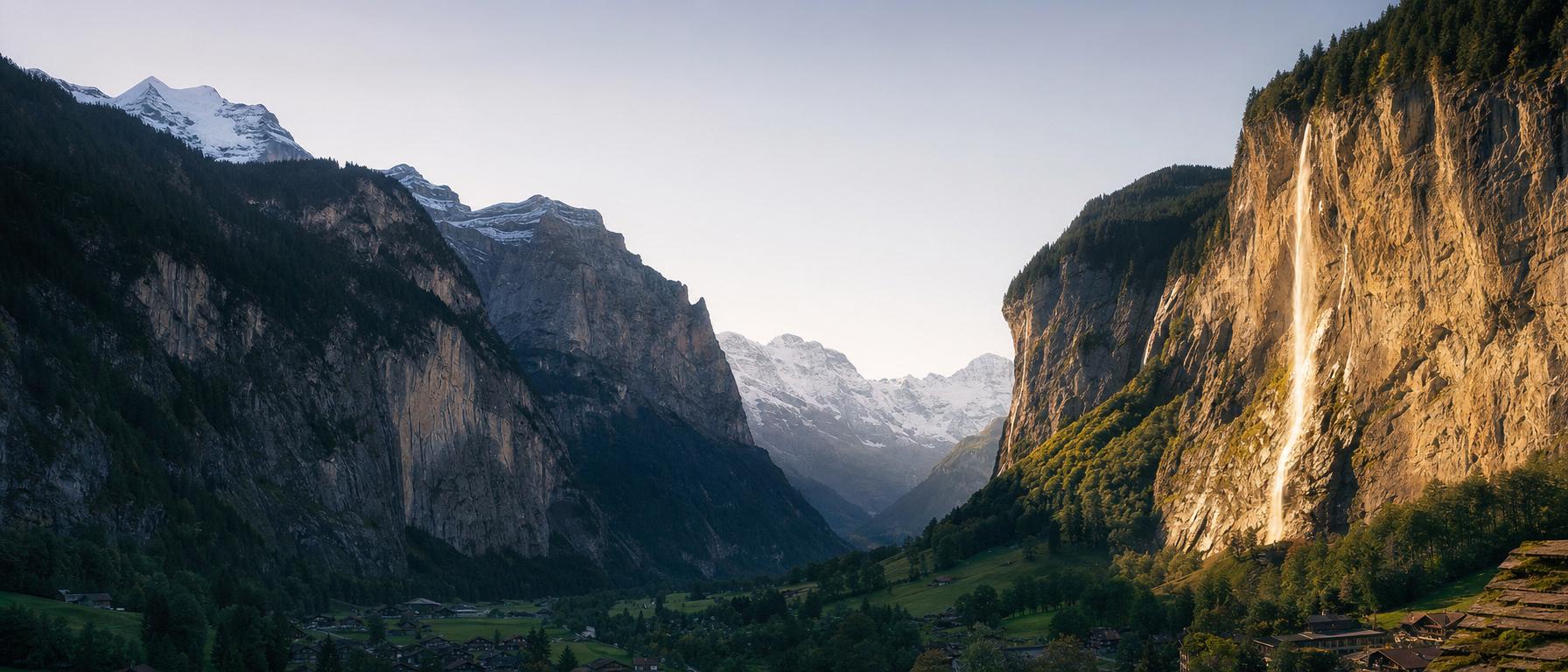
The trip's most iconic nature stop: the classic Swiss valley of waterfalls. The train from Interlaken Ost to Lauterbrunnen takes about 20 minutes, and the station is modern and barrier-free. Staubbach Falls, at about 297 m and free to visit, is the valley landmark, about a 5-minute walk from the station and especially magical in morning light.
- Staubbach Falls (~297 m), one of Europe's tallest free-falling waterfalls, free to visit
- Dramatic glacial valley walled by cliffs and threaded with waterfalls
- Barrier-free, modern Lauterbrunnen station only ~20 minutes from Interlaken Ost
- Morning light on Staubbach for the iconic single-fall photo
Things to do
- Walk to Staubbach Falls — About a 5-minute walk from the station; stroller-friendly to the village viewpoints, carrier best on any uneven edge paths. Toilets and food near the station/village center.
- Photograph the valley — Village approach with the waterfall centered, plus broader valley framing from farther back in Lauterbrunnen rather than only at the base of the falls.
- Lunch in the village — Soup, rösti, pasta, pizza, sandwiches, or a small picnic; easy baby options like puree/pouch, banana, oats, yogurt.
Tips
- Sit at the front of the Bernese Oberland train so one parent can watch the train-split instructions and avoid boarding errors.
- Carry a light rain cover: waterfall spray and valley showers happen without warning.
- Backup: if the baby is tired, stay only in Lauterbrunnen and skip Wengen; Staubbach and the valley already deliver the core scenic value.
- Self-drive warning: the Lauterbrunnen approach can have snow and black ice in winter/shoulder weather.
Best for
The signature waterfall-valley image that earns the journey from Delhi
Cost
Free to visit; train fare only (Interlaken ↔ Lauterbrunnen ↔ Wengen CHF 35-90 for 2 adults depending on pass).
Wengen (car-free mountain village)
A car-free village at 1,274 m, high enough to feel alpine without becoming your sleeping altitude. Peaceful and compact, it suits a gentle 60-90 minute stop for a stroller loop or carrier walk with mountain panoramas, an easy 'high village' counterpoint to the valley below.
- Car-free alpine village at 1,274 m with chalet atmosphere
- Mountain panoramas without forcing a higher, riskier ascent
- Quiet, compact core that's easy with a stroller or carrier
Things to do
- Village panorama stroll — Spend about 60-90 minutes; treat Wengen as the 'high village panorama' day, not a cram-everything day. Enjoy the views, take a café or park-bench nap break.
- Optional Wengen-Männlichen cable car — Officially family-friendly; adult return from CHF 62 full fare / CHF 31 with Swiss Half Fare Card from Wengen, children under 6 free. Keep optional rather than essential to avoid overbooking and ruining the evening.
Tips
- Do not force extra lifts just because you are already up here; many parents overbook a cable car and ruin the evening.
- If the baby looks overtired after Lauterbrunnen, skip Wengen and return after lunch with no loss of accommodation value.
- Altitude risk is low at Wengen's level, but if the baby shows unexplained fussiness, poor feeding, or pallor after the ascent, descend and rest.
Best for
Alpine-village atmosphere and panorama without going to a high sleeping altitude
Cost
Transport only; optional Männlichen cable car CHF 31-62 per adult round trip from Wengen.
Lake Brienz Cruise
A leisurely cruise on famously turquoise Lake Brienz, boarded right at the Interlaken Ost jetty with no extra bus changes. A full round trip takes about 2 hours 30 minutes and one way about 1 hour 15 minutes. Boats are one of the most baby-friendly scenic modes: minimal walking, great nap potential, and weather protection on many sailings.
- Famous turquoise water framed by steep mountain walls
- Boards directly at the Interlaken Ost jetty, no bus transfer
- Excellent for naps in motion and weather-protected on many sailings
- Broadest moving lake panorama of the trip
Things to do
- Cruise toward Giessbach See — Take the boat toward Giessbach See; round trip ~2h30, one way ~1h15. Check live BLS lake fares and timetables before departure.
- Use the boat as a scenic nap — If your child naps best in motion, this may become the easiest day of the trip; on a stormy or cranky day, simply ride and return to Interlaken with no guilt.
Tips
- Carry rain cover, compact towel, extra baby layer, snacks, formula/water, and a carrier even if you bring a stroller.
- If it rains heavily, keep the boat and skip Giessbach walking; a covered cruise plus a café stop still preserves the spirit of the day.
- Best rainy-day scenic option in the whole plan: a covered Lake Brienz (or Lake Thun) boat segment.
Best for
A calm, photogenic lake day that balances the mountain days and protects naps
Cost
Lake Brienz boat CHF 31-72 per adult depending on route ticket, Lake Brienz day pass, or larger regional pass.
Giessbach Falls & Historic Funicular
A dramatic, multi-tiered waterfall tumbling toward Lake Brienz beside a grand old hotel, reached by a historic funicular from the lake. The funicular runs mainly April-October with limited winter operation. The atmosphere, not ticking off a trail, is the point: waterfall, lake outlook, and a slower rhythm.
- Dramatic lake-and-falls combination many first-time itineraries miss
- Historic Giessbach funicular climbing from the lakeshore
- Grand old hotel setting with a waterfall and lake outlook
- Best waterfall view for drama (paired with Staubbach for the iconic single fall)
Things to do
- Ride the historic funicular — Get off the boat at Giessbach See and ride uphill. Roughly CHF 7 one-way adult. Stroller transport is possible but limited and not guaranteed, and the funicular is not wheelchair-accessible, so a carrier is the better tool.
- Unhurried waterfall and lake time — Eat at the hotel/restaurant area or bring a picnic. Let a nap happen in carrier or stroller while one parent walks a short section near the falls.
Tips
- Bring a baby carrier here even if you are a dedicated stroller family; this is the spot where it matters most.
- Do not try to push a full waterfall trail if surfaces are wet.
- If the funicular feels too awkward with the stroller, don't force it.
Best for
The dramatic waterfall-meets-turquoise-lake scene, best done slowly with a carrier
Cost
Funicular about CHF 7 one-way adult (round-trip if needed).
Brienz Promenade or Iseltwald
Choose one calm lakeside village to wind down the lake day, not both at full depth. Brienz offers a lakeside promenade and water-play area with easier stroller surfaces; Iseltwald is the prettiest calm-lake-village mood with very little walking and a beautiful lido lawn.
- Brienz: lakeside promenade and water-play area, good for snack stops and stroller surfaces
- Iseltwald: beautiful lido lawn with unique mountain-and-water views
- Either makes a relaxed blanket break or simple family photo
Things to do
- Option A: Brienz promenade — Best if your baby wants space, snack stops, and an easier stroller surface; lakefront/water-play area suits family downtime.
- Option B: Iseltwald short stop — Best for the prettiest calm-lake-village mood with very little walking; the lido lawn works well for a blanket break or family photo.
Tips
- Pick only one to avoid overpacking the afternoon; return late afternoon before everyone gets cold and done with water views.
- If the baby is asleep, you can simply stay on the boat instead of stopping.
- Iseltwald lido lawn and Brienz lakeside promenade are the best baby-friendly picnic spots.
Best for
A gentle lakeside finish to the cruise day
Cost
Free to visit; train/boat add-on CHF 0-30.
Harder Kulm (Two-Lakes Viewpoint)
The trip's best low-effort viewpoint and the best effort-to-reward attraction in the whole plan. The funicular takes only about 10 minutes from a valley station near Interlaken Ost up to 1,322 m, and the lookout shows Lake Thun, Lake Brienz, and the Eiger-Mönch-Jungfrau. Interlaken Tourism explicitly marks the Harder funicular as pushchair-suitable, barrier-free, and fine for children of all ages.
- Both lakes plus Eiger, Mönch, and Jungfrau from one platform at 1,322 m
- Only a ~10-minute funicular ride, pushchair-suitable and barrier-free
- Best low-effort viewpoint and best mountain view in the plan
- Best sunset spot, with dedicated evening trips
Things to do
- Ride the Harder funicular — Walk to the Harder Railway valley station near Interlaken Ost; the ride is ~10 minutes to 1,322 m. Ticket offers start from CHF 19; actual round-trip price depends on fare type and discounts.
- Two-Lakes lookout platform — The signature photo spot. Best in morning or near sunset; mid-morning is the sweet spot for a baby schedule. Stroller works in the main lookout/restaurant zone; carrier better for the wooded circular route.
Tips
- Go in the morning for the safest family experience; crowd risk rises at peak season and around sunset.
- If the weather is hazy, don't linger: take photos, have a snack, and move on.
- If clouds kill the view, switch the whole day to Spiez / lakeside only and keep Harder as a same-day optional extra.
- Hold toddlers at the platform edges.
Best for
The biggest scenery-to-effort payoff of the trip, perfect for a baby schedule
Cost
Tickets from CHF 19; for 2 adults roughly CHF 38-100 depending on ticket/discount.
Spiez & Lake Thun
A calmer, softer lakeside counterpoint to busy central Interlaken, reached by an easy train or boat leg. Switzerland Tourism highlights Spiez for its bay, castle park, promenade, and boat setting, exactly what a couple with a baby wants after the viewpoint. Spiez is also the prettiest area for a quiet lakeside stay.
- Pretty bay with castle, vineyards, promenade, and mountain backdrop
- Easiest static lake photo of the trip (lake + castle in frame)
- Calm, soft evening atmosphere ideal after an active day
Things to do
- Lakeside promenade and bench time — The best version is simple: lakeside promenade, family photos, optional castle exterior/park if energy allows, then an early return.
- Lake Thun boat segment — If you prefer pure lake scenery over another town stop, swap Spiez for a Lake Thun boat segment; recheck live BLS timetables and fares before departure.
Tips
- Train ↔ Spiez or a Lake Thun segment is the gentle close to the viewpoint day.
- Skip if you're already fully satisfied after Harder Kulm; this is an optional add-on.
- Spiez is the best area to stay for views, though slightly less central for daily day-trips than Interlaken.
Best for
A soft, scenic wind-down and the easiest lake-and-castle photo
Cost
Free to visit; Interlaken ↔ Spiez or Lake Thun segment CHF 15-40.
Day by day
Arrival and settle into Interlaken base
Morning
Fly into Zurich, clear immigration, and head to the airport SBB travel center for train tickets. Take the train straight to Interlaken with luggage instead of stopping in Zurich city. Use trains rather than a rental car to avoid car-seat complications on arrival day.
Midday
Check into hotel and prioritize the baby's first proper feed and nap. Once the baby sleeps, one parent can stock up at Coop Interlaken Ost with baby supplies (formula, diapers, wipes, pouches). Keep lunch simple: soup, pasta, sandwich, or yogurt.
Afternoon
Do an easy outing on Höheweg/Höhematte in Interlaken (pushchair-suitable, mountain backdrop, 45-75 minutes only). Test whether the baby prefers stroller, carrier, or hotel cot under Swiss daylight timing.
Evening
Eat dinner early near the hotel and do the bath-and-sleep routine as close to home rhythm as possible. Pack the next day's small day bag with diapers, wipes, layers, feed supplies, and snacks.
Heads-up
Baby overtiredness and parent fatigue are the main risks. If the flight is delayed or baby is fussy, skip the walk entirely; reaching the hotel, buying supplies, feeding, and sleeping is enough.
Lauterbrunnen, Staubbach Falls, and Wengen
Morning
Wake early and have 7:00-8:00 a.m. breakfast. Take the 20-minute train from Interlaken Ost to Lauterbrunnen. At the station, walk 5 minutes to Staubbach Falls; morning light is especially magical, and the stroller-friendly village viewpoints offer excellent photo spots. Carry a light rain cover for waterfall spray.
Midday
Have lunch in Lauterbrunnen or take the short train to Wengen before lunch. Wengen is car-free, peaceful, and compact enough for a stroller loop without pressure. Let the baby nap in a café or park bench area if needed.
Afternoon
If the nap went well, spend 60-90 minutes in Wengen exploring the alpine-chalet atmosphere and mountain panorama. Do not force extra lifts; Wengen alone provides the memorable alpine feel. The optional Wengen–Männlichen cable car is family-friendly but not essential (CHF 31–62 per adult from Wengen).
Evening
Return to hotel by 5:00-6:00 p.m. to allow time for baby dinner, bath, and unhurried sleep. If energy remains, do only a 20-minute low-effort walk near the hotel.
Heads-up
Crowding and overtiredness are the main risks, not danger. Keep the day modular: if weather turns wet or the baby becomes irritable, descend immediately. Wengen's altitude is low compared with high summits; descend if the baby shows unexplained fussiness, poor feeding, or pallor.
Lake Brienz cruise, Giessbach Falls, and lake villages
Morning
Start slowly and get to Interlaken Ost jetty. Board a Lake Brienz boat toward Giessbach See; these boats are very baby-friendly with minimal walking and great nap potential. Ride the historic Giessbach funicular uphill if energy allows, but note that stroller transport is limited and a baby carrier is the better tool here.
Midday
Spend the midday window at Giessbach in unhurried fashion: enjoy the waterfall, lake outlook, and grand hotel setting. Eat at the hotel/restaurant or bring a picnic. If the baby is sleepy, let the nap happen while one parent walks near the falls and the other stays put. Do not push full waterfall trails if surfaces are wet.
Afternoon
Choose one stop (not both): Brienz promenade for lakeside family downtime with stroller-friendly surfaces, or Iseltwald for the prettiest calm-lake-village mood with beautiful lawn and unique mountain-and-water views.
Evening
Return to hotel by early evening. This is a good laundry and reset night. Refill the diaper pouch and check the next day's weather forecast since Day Four is more weather-sensitive.
Heads-up
Main risk is weather and stroller frustration. In heavy rain, skip Giessbach walking but keep the covered boat cruise and café stop. If funicular feels awkward with the stroller, do not force it.
Harder Kulm viewpoint and Lake Thun/Spiez
Morning
Keep breakfast relaxed and leave after the baby's first feed and diaper change. Walk to Harder Railway valley station near Interlaken Ost. The mountain sits at 1,322 m; the 10-minute funicular ride is the best effort-to-reward attraction, showing Lake Thun, Lake Brienz, and the Eiger-Mönch-Jungfrau panorama. Stroller works in the main lookout zone; a carrier is better for the wooded circular route. The Two-Lakes lookout platform is the best photo spot.
Midday
Either eat at the Harder Kulm restaurant or descend for lunch before the baby's main nap. If weather is hazy, do not linger; take photos, enjoy a quick snack, and move on since Harder is about the view.
Afternoon
Take an easy train or boat to Spiez on Lake Thun. Enjoy the bay, castle park, promenade, and calmer vibe than central Interlaken. The best version is simple: lakeside promenade, bench time, family photos, optional castle exterior/park if energy allows, and early return.
Evening
Return by 6:00-7:00 p.m. Have easy dinner and begin packing. Keep Day Five nearly empty except the airport transfer. Finish laundry and organize liquids, baby food, and hand baggage.
Heads-up
Go to Harder in the morning to avoid crowds and enjoy optimal light. If clouds ruin the view or the baby is not in the mood, switch to Spiez/lakeside only and keep Harder as a same-day optional extra.
Departure to Zurich
Morning
Pack early. Feed the baby in calm conditions at the hotel, not on the platform. Leave a generous buffer for Swiss rail punctuality plus airport procedures. If flying SWISS, online check-in opens 24 hours before departure, so do this the previous day. Buy a small amount of local currency only if needed.
Midday
At the airport, use remaining local currency on snacks, baby items, or small essentials. Keep one full feed's worth of baby supplies accessible after security.
Afternoon
No formal sightseeing. Your 'activity' is a smooth departure.
Evening
In-flight routine: change the baby's diaper before boarding and feed during takeoff if appropriate. Keep one complete change of clothes for the baby and one top for each parent in cabin baggage.
Heads-up
If you have an early flight, take the last quiet evening possible on Day Four and sleep early rather than attempting a final sunset outing. If a rail delay causes stress, Zurich Airport's integrated train system and SBB support desk are easier to navigate than a long road transfer.
What it costs
All INR figures use 1 CHF ≈ ₹121.6. Switzerland-side spend for 2 adults + one baby over 5 days, with flights and Schengen visa fees shown separately. Mid-range comfort typically lands around CHF 3,300-4,800 (~₹4.0-5.8 lakh) plus flights and visa fees.
Flights from Delhi (return, 2 adults)
Budget ₹1.2-1.65 lakh; premium ₹2.0-3.2 lakh. Snapshots show economy returns roughly mid-₹50,000s to mid-₹70,000s; nonstop SWISS/Air India around mid-₹70,000s, cheaper 1-stop from low-₹50,000s.
Mid-range ₹1.5-2.1 lakh
Hotels (5 days)
Budget CHF 720-1,000; premium CHF 1,800-2,800. Nightly: budget CHF 180-250, mid-range CHF 250-380, premium CHF 380-650, luxury CHF 650-1,700+.
Mid-range CHF 1,050-1,500
Local transport
Budget CHF 300-520; premium CHF 700-1,200.
Mid-range CHF 380-650
Food
Budget CHF 220-320; premium CHF 450-700.
Mid-range CHF 320-460
Attractions
Budget CHF 80-170; premium CHF 200-350.
Mid-range CHF 140-260
Baby supplies
Budget CHF 30-80; premium CHF 60-120.
Mid-range CHF 50-100
SIM / eSIM
Budget CHF 10-20; premium CHF 20-40.
Mid-range CHF 15-30
Travel insurance
Must meet EUR 30,000 minimum medical/repatriation per person for Schengen.
Mid-range CHF 60-120
Emergency buffer
Budget CHF 150-250; premium CHF 300-500.
Mid-range CHF 200-350
Total Switzerland-side (5 days)
Budget CHF 2,550-3,650 (~₹3.1-4.4 lakh); premium CHF 5,000-7,500 (~₹6.1-9.1 lakh). All plus flights and visa fees.
Mid-range CHF 3,300-4,800 (~₹4.0-5.8 lakh)
Schengen visa fees
Baby usually free; VFS service/courier charges still apply. Billed in EUR, not CHF.
EUR 90 per adult; EUR 45 children 6-12; free under 6
Swiss Half Fare Card
Valid one month, up to 50% off trains, boats, and many mountain lines. Children under 6 free; children 6-15.99 free with Swiss Family Card attached to an adult pass.
CHF 150 per adult
Good to know
Visa & entry
Indian passport holders need a Schengen visa, and there are specific requirements for traveling with a baby.
- Passport requirements — Passport must be issued within the last 10 years with at least 3 months' validity after scheduled return and at least two blank pages. Minor applications must be signed by legal guardians.
- Visa consent rules — If a child is not traveling with both parents, notarized consent is required. If traveling alone, consent from both parents/legal guardians is required.
- Visa cost — EUR 90 per adult, EUR 45 for children aged 6–12, and free for children under 6.
- Travel insurance minimum — Schengen requirement is EUR 30,000 per person for medical and repatriation expenses.
- Application process — Applications go through VFS in India. Consular services are outsourced to VFS Global in Bern from July 1, 2025 onward.
- Consular contact (Indian travelers) — For Indian travelers, the Embassy of India in Bern is the key consular contact. The embassy site currently lists contact emails and phone numbers, and notes that consular services are outsourced to VFS Global in Bern from 1 July 2025 onward.
Getting around
Public transport is the easiest and safest option for this trip; car rental adds stress with no real benefit.
- Airport to hotel — Train from Zurich Airport to Interlaken is best value and safest default. Trains depart every 10 minutes to Zürich HB. Private transfer is much more expensive (hundreds of euros each way).
- Best pass choice — Swiss Half Fare Card (CHF 150 per adult, valid one month) gives up to 50% discounts on trains, boats, and mountain excursions. Children under 6 travel free; children 6–15.99 travel free with Swiss Family Card when attached to an adult pass.
- Swiss Travel Pass note — If you prize simplicity over minimal cost and might add broader Swiss movement, the Swiss Travel Pass is the easiest all-Switzerland product, though it often is not the absolute cheapest for a one-base Interlaken stay (versus the Berner Oberland Pass).
- Stroller advice — Bring a compact, one-hand-fold travel stroller, not a giant system. SBB provides pushchair compartments/family areas on trains.
- Baby carrier essential — Bring a baby carrier even if you are a stroller-focused family. Essential for Giessbach funicular, station changes, crowded platforms, and days when stroller naps fail.
- Car seat if self-driving — Bring your own if using any private transfer or rental car; CDC notes that car seats abroad may not meet expected standards.
- Luggage handling — Keep luggage lighter than normal. Two medium suitcases + one stroller + one carrier is realistic. SBB provides luggage help at Zurich Airport travel center.
Health & baby
Altitude is the main concern; children are as susceptible as adults to elevation effects.
- Altitude ascent strategy — CDC recommends slow ascent and day trips higher with sleeping lower rather than sleeping at altitude. This plan avoids summit stays like Jungfraujoch to protect the baby's routine.
- Altitude illness signs — In preverbal children, altitude illness may show as poor feeding, irritability/fussiness, sleep changes, or pallor. If these appear, descend and rest immediately.
- Baby supplies locally — Coop and Migros stock formula, porridge, squeeze pouches, jars, diapers, and wipes. Buy locally after arrival rather than overpacking consumables.
- Pharmacy access — Interlaken has conveniently placed pharmacies such as Amavita Apotheke Bichsel Interlaken. Supermarkets are open weekdays with reduced Sunday hours, so stock up on arrival day.
- Emergency numbers — European emergency 112, ambulance 144, poison control 145. Interlaken area emergency departments (FMI hospital system) operate 24 hours, 365 days a year.
- All Swiss emergency numbers — The official Swiss numbers are 112 European emergency, 117 police, 118 fire, 144 ambulance, 145 poison control, and 147 youth helpline. Switzerland's official public portal also lists the FDFA helpline.
Food & water
Keep meals predictable and simple on active days; carry backup snacks to avoid restaurant hunting.
- Eating strategy — Hotel breakfast if included or simple supermarket breakfast in-room, light lunch or picnic on scenic days, calm early dinner near hotel. This avoids restaurant hunting on mountain/boat days.
- Baby meal backup — Do not assume Indian food or customized baby meals on mountains or boats. Carry at least one sure meal/snack kit daily. Soft bread, fruit, cheese, plain pasta, yogurt, and pouches work well.
- Vegetarian note — Town bases like Interlaken and Spiez offer supermarket salads, breads, fruit, yogurt, pasta, pizza, and soups. This simplifies vegetarian eating on the move.
- Emergency snacks — Pack pouches, crackers, bananas, applesauce, formula sachets, dry cereal, toddler biscuits, and nuts for adults. Keep hydration salts if pediatrician recommends.
- Drinking water — Carry refillable bottles. Ask the hotel if tap water is potable in-room; when uncertain, buy bottled water without hesitation.
Packing
Pack for flexibility and disruption rather than assuming the perfect plan.
- Cabin bag essentials — Carry 8–10 hours' worth of diapers, wipes, changing mat, rash cream, 2–3 spare outfits, bibs, light blanket, warm layer, full feeding kit, medicines, thermometer, pacifier, teether, quiet toy, wet bags, sanitizer, and tissues.
- Checked luggage — Extra diapers for first two days, seasonal clothing, sleepwear, baby toiletries, stroller, laundry soap strips, and feeding items. Skip portable cot unless your baby needs it.
- Nature gear — Carrier, compact stroller, stroller rain cover, sun hat, warm layers, socks, lightweight blanket, compact first-aid kit, baby-safe sunscreen if approved by pediatrician.
- Do not overpack — Avoid diapers/baby food for all 5 days unless medically necessary, bulky toys, oversized stroller, or too many adult clothing changes. Do carry prescription medicines and unusual formula.
- Weather layers — Always carry one warm layer and one waterproof layer for baby, even on clear mornings. Swiss weather can turn quickly.
Money & costs
Five-day trip on-ground costs range CHF 2,550–4,800 plus flights and visa fees, depending on comfort level.
- Mid-range budget breakdown — Hotels CHF 1,050–1,500, local transport CHF 380–650, food CHF 320–460, attractions CHF 140–260, baby supplies CHF 50–100. Total roughly CHF 3,300–4,800 plus flights and visa (₹4.0–5.8 lakh approx.).
- Flight cost — Current Delhi–Zurich economy ranges roughly ₹50,000–70,000 return. SWISS and Air India nonstop around mid-₹70,000s; cheaper 1-stop fares start low-₹50,000s.
- Where to save — One base only, half-fare transport, supermarket breakfasts/picnics, simple lunches on scenic days, avoid high-summit 'checklist' rides.
- What not to compromise — Room quality, cot confirmation, heating/ventilation, rain layers, fast pharmacy access, travel insurance, realistic daily rhythm.
- Cash vs card — Cards widely accepted. Keep small CHF amount for kiosks, toilets, small purchases. Switzerland not a heavy-tipping destination; rounding up is usually enough.
Booking timeline
Book in order: flights first, then hotel immediately, then transport passes and confirmations.
- Before booking flights — Check passport validity for both adults and baby (10+ years remaining), confirm Schengen visa timing, verify baby's own passport/documentation, confirm travel insurance at EUR 30,000+ minimum. Pick season first (late June to mid-September ideal).
- After booking flights — Book hotel immediately—Swiss family rooms disappear fast in peak months. Request in writing: baby cot, quiet room, elevator access, fridge/kettle, early check-in or luggage hold.
- Transport passes — Buy or shortlist Swiss Half Fare Card (CHF 150 per adult) or Berner Oberland Pass (3+ days, free trains/boats/lifts in region). For simplicity, Half Fare Card usually best value for this itinerary.
- Seven days before — Recheck Jungfrau live operating info, BLS boat timetable, Zurich airport rail, hotel cot confirmation, pharmacy/hospital locations, weather forecast. Download offline maps, SBB app, confirmations, visas, insurance.
- 24 hours before — Web check-in if available (SWISS opens 24 hours before departure). Pack cabin food/diaper system, charge devices, lay out airport clothes for baby and both adults.
Where to stay
Best base is Interlaken Ost or Unterseen for convenience, Wilderswil for better value.
- Interlaken Ost (best convenience) — Strongest operational base: close to trains, boats, supermarkets, pharmacies. Höheweg is pushchair-friendly. Easy to use when naps change plans.
- Unterseen (best baby calm) — Sits just outside busiest tourist flow. Interlaken Tourism describes it as 'peace and quiet' only steps from center—exactly the baby-travel sweet spot.
- Wilderswil (best budget) — Quieter, usually cheaper than central Interlaken, still close to Lauterbrunnen or Interlaken. Hotel listings consistently show better-value family rates than central area.
- Hotel search filters — Search for 'family room,' 'free cancellation,' 'cot/cradle available,' 'lift/elevator,' 'private bathroom,' 'quiet rooms,' 'breakfast included,' 'station within 500m,' 'supermarket within 500m,' 'heating/AC,' 'washing machine' if apartment.
- Typical nightly rates — Budget comfort CHF 180–250 (guesthouse/2–3*), mid-range CHF 250–380 (3–4* hotel), premium CHF 380–650 (4* superior/lakeside). Current Interlaken snapshots show examples roughly CHF 180 to 1,700+.
Plan our savings
Pick when we'd go, and see what Interlaken: Baby-Friendly Mountains, Lakes & Waterfalls costs as a monthly saving — in two perspectives.