Japan · Yamanashi, Fuji Five Lakes
Fuji Five Lakes Slow Escape
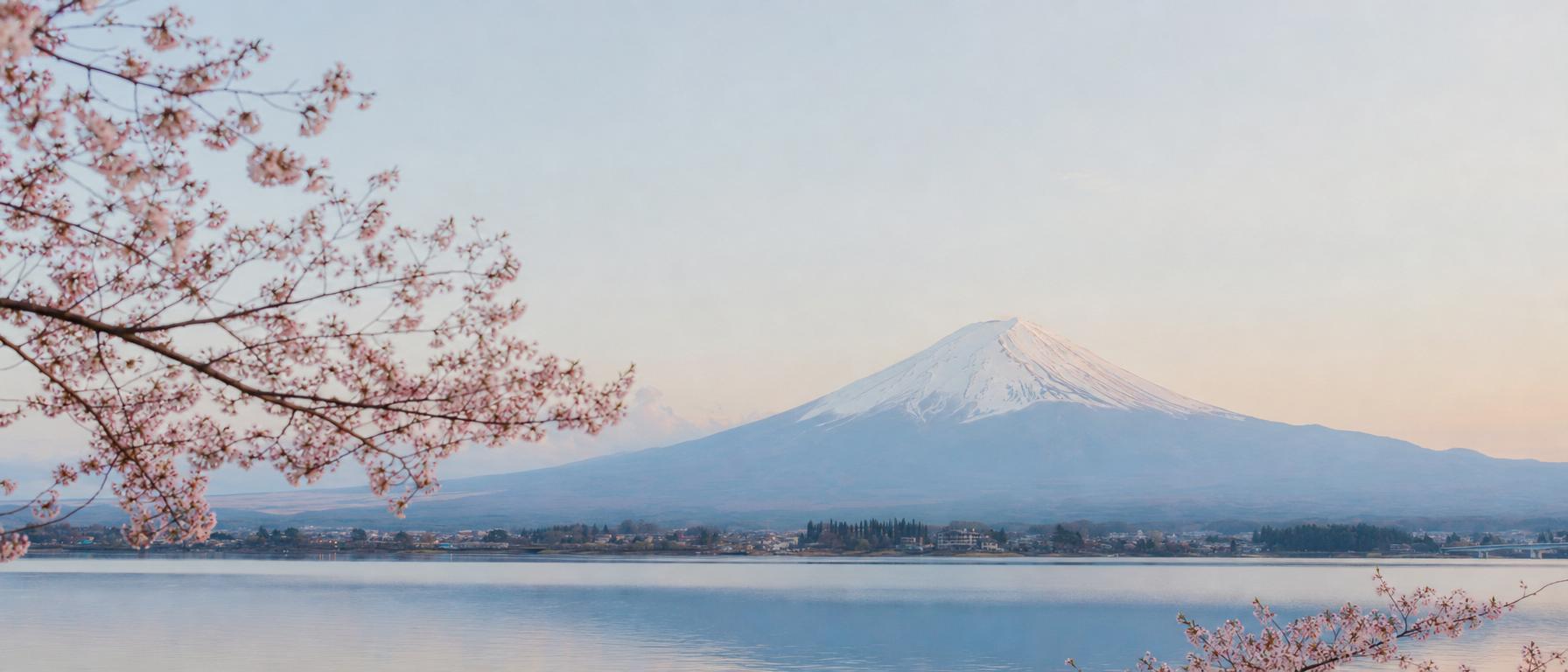
Mt. Fuji over still lakes, one quiet base, and a baby-paced rhythm.
For a couple traveling from Delhi with one small baby and only five days, the strongest "pick and go" option in Japan is a slow, single-base Lake Kawaguchiko trip using Tokyo Haneda as the gateway. It gives the best balance of iconic mountain-and-lake scenery, direct airport access, baby-manageable days, very low hotel-hopping, and enough flexibility to add a waterfall day without turning the trip into a logistics exercise. We unpack once, settle into a quiet lakefront hotel, and let Mt. Fuji do the work.
The Fuji Five Lakes are one of the most visually rewarding short-stay nature regions in Japan, with especially strong photo conditions in spring and autumn. From a single base near Kawaguchiko we reach iconic, easy stops: Oishi Park on the north shore, the Mt. Fuji Panoramic Ropeway, a gentle lake boat ride, the thatched-roof village of Saiko Iyashi-no-Sato Nenba, and the spring-fed ponds of Oshino Hakkai. There are no intercity hotel moves and no strenuous hiking required.
The plan is built around the baby: one hotel base, a direct reserved airport bus from Haneda, relaxed mornings for the best Fuji visibility, midday nap returns, easy stroller time at lakeside parks, and pharmacies and supermarkets close at hand. A carrier comes out for the stair-heavy or uneven sites; the stroller handles airports, town, and Oishi Park. The main trade-off is that Fuji's visibility is weather-dependent, and the most photogenic moments come early in the day.
Japan currently allows India-based applicants to use the Japan eVISA route through VFS Global for single-entry tourism stays of up to 90 days, and no longer requires a COVID vaccination certificate or pre-departure test. Travel insurance remains strongly recommended, as Japan's official tourism authority warns treatment can be expensive. All costs below are shown in JPY first with INR approximations, using roughly ¥100 = ₹60.
Duration
5 days / 4 nights
Best window
15 April–25 May; 1–20 November as cooler 2nd choice
Home base
Asakawa Onsen / east lakefront Kawaguchiko (4 nights, no hotel changes)
Gateway
Tokyo Haneda, in and out
Main transport
Reserved Haneda–Kawaguchiko airport bus + local sightseeing buses + short taxis
Est. budget (mid-range)
¥290,000–¥430,000 (~₹2.39–3.92 lakh for 2 adults + baby)
Climate
Lake at ~830 m; mild in May, drier in November; wet/humid summers
Total distance / transport time
~330–420 km whole trip; ~10–13 hours total transport
When to go
Spring and autumn are Japan's most comfortable outdoor seasons. Kawaguchiko is mild in May and much drier in November than in the rainy and typhoon-prone months.
✓ Best months
Mid-April to late May (15 April–25 May, safest baby-weather balance); early to mid-November (1–20 November, prettier foliage but cooler mornings).
✕ Avoid
Late June to early July (rain); late August to September (heat, humidity, higher typhoon disruption risk).
Mt. Fuji visibility is weather-dependent and best in the morning before haze builds. Mountain weather changes faster than city weather, so pack layers and rain gear in every season.
Places to visit
Everywhere we go inside Fuji Five Lakes Slow Escape, and what to do at each.
Lake Kawaguchiko (Asakawa Onsen / east lakefront base)
The single home base for the whole trip — a scenic, quieter lakefront belt that balances views, restful sleep, station access, and an easy baby routine. Lake Kawaguchiko sits at about 830 m, gentle for most families.
- Postcard Mt. Fuji-over-lake framing, strongest on the north shore in the morning
- Peaceful lakefront mornings and easy promenade walks
- One hotel, zero intercity moves — unpack once
- Pharmacies, supermarkets and the Forest Mall within town reach
Things to do
- Lakefront walk near the hotel — A 30–45 minute low-energy stroll on arrival day; first Fuji photos from the lakefront if the mountain is visible, then stop to preserve energy.
- Sunset / blue-hour stroll — An easy 10–20 minute lakefront walk after dinner — the lowest-energy sunset plan, better with a baby than a distant viewpoint.
- Stock up on supplies — Welcia drugstore ~9 minutes on foot from Kawaguchiko Station; MaxValu supermarket and the Forest Mall shopping area in the wider lake zone for diapers, wipes, water, fruit, yogurt, bread and baby food.
Tips
- Asakawa lakefront bus stop is roughly 14 minutes by sightseeing bus from Kawaguchiko Station; many hotels in this belt offer station shuttles if arranged in advance.
- North shore (Oishi/Kawaguchi) is best for views but less station-convenient; Kawaguchiko Station/Funatsu is best for convenience; Kodachi/Forest Mall side is best for budget.
- Book by room and property type first, not by hotel name. Use filters: non-smoking, twin/family room, private bath, elevator, breakfast included, free cancellation, lake/Fuji view, station shuttle, and crib/cot on request.
- Request a baby cot and a quiet room with elevator access at booking time.
Best for
A scenic, restful single base that keeps a baby routine intact.
Cost
Mid-range room ¥22,000–¥40,000/night (₹13,120–₹23,860); budget ¥10,000–¥18,000; premium ¥45,000–¥80,000; luxury ¥90,000+ (e.g. HOSHINOYA Fuji, FUFU Kawaguchiko). Entry-level rooms can start ~₹6,000/night.
Oishi Park
A free-entry north-shore park facing Mt. Fuji across the lake, with a long flower path, café/restaurant building, and family-friendly open space. The best stroller morning and best family photo spot of the trip.
- Wide, free Mt. Fuji-and-lake views from the north shore (JNTO's recommended side)
- Long seasonal flower path along the lake
- Excellent stroller terrain and open space
- Indoor food and a view café for weather flexibility
Things to do
- Walk the flower path — Spring flowers late April–early May, lavender late June into early July, red kochia in late October. Combines lake, flowers and Fuji with almost no physical effort.
- Morning Fuji photography — Best Fuji views are often in the morning before haze builds; spend 60–90 minutes and leave before crowds build.
- Lunch at the Natural Living Center — On-site café/restaurant spaces and a farmers' market — better than moving to a second location while everyone is hungry. Also the best rainy-day scenic spot.
Tips
- Stroller-friendly: yes. Carrier not required.
- From an Asakawa/Funatsu hotel allow ~20–30 minutes by sightseeing bus or ~10–15 minutes by taxi.
- Carry a light blanket, spare bib, wipes, milk, a lightweight rain cover and one small toy.
- If Fuji is hidden, still come for the lakeside walk and café.
Best for
Easy, breathtaking morning views and the best baby-friendly picnic spot.
Cost
Free entry.
Mt. Fuji Panoramic Ropeway
A short cable car to an observatory at around 1,075 m for the trip's best mountain view deck — the classic easy-reward duo with the lake boat.
- High Fuji-and-lake viewpoint without strenuous hiking
- Compact half-day that bundles lake, mountain and high-point wishes
- Summit deck at ~1,075 m, still gentle day-trip territory
Things to do
- Ride to the observatory deck — Round-trip ¥1,000/adult, ¥500/child; preschool children free with accompanying adults. Hours typically 8:30–17:00 (extended to 18:00 in the summer holiday period).
- Pair with the lake boat using the V coupon — Ropeway + boat combo ¥1,700/adult, ¥850/child — the simplest value ticket if doing both.
Tips
- Use a carrier, not the stroller: 64 steps at the lakeside station and 112 steps at the upper station; the operator says wheelchair movement is difficult.
- Go after the midday nap if visibility looks good; expect moderate-to-high crowds in good weather.
- Stroller-friendly: poor. Carrier needed.
Best for
The trip's best mountain-view deck with minimal effort (carrier on).
Cost
¥1,000/adult round trip; ¥500/child; preschoolers free. Combo with boat ¥1,700/adult.
Lake Kawaguchiko Sightseeing Boat "Appare"
A short, calm lake cruise that completes the lake-mountain-high-point trio in a single half-day. Pre-schoolers ride free.
- Gentle 30–45 minute cruise with on-water Fuji views
- Low-effort, baby-manageable activity
- Pairs naturally with the ropeway
Things to do
- Take the "Appare" cruise — ¥1,000/adult, ¥500/child, pre-schoolers free. Best on a clear afternoon.
Tips
- Check the operator's published 2026 regular closure dates — several Tuesdays in June and selected dates in December/January — and don't place the boat at the center of your plan if those match your trip.
- Fold the stroller for boarding; a carrier is helpful. If closed or too windy, swap for a flat lakefront walk.
- Skip if it's an operator closure day or too windy.
Best for
A calm on-water Fuji moment to round out the iconic day.
Cost
¥1,000/adult, ¥500/child, pre-schoolers free; or via ¥1,700/adult combo with the ropeway.
Saiko Iyashi-no-Sato Nenba
A restored thatched-roof village with an old-Japan feel — open views, short strolling, places to sit, craft and tea houses, and on-site food. A quieter, more old-Japan-feeling nature day away from central Kawaguchiko.
- Traditional thatched-roof (kayabuki) houses framed against the mountains
- Open views mixed with short, easy strolling
- Tea house, restaurants, rest area and specialty/craft shops on site
- Quieter and less crowded than central Kawaguchiko or Oshino
Things to do
- Explore the thatched village — Hours 9:00–17:00 (March–November) and 9:30–16:30 (December–February); admission ¥500/adult, ¥250/child; free parking. Spend about 90 minutes.
- Lunch on-site — Tea house and restaurants inside the village complex; eat early, then return for the baby's nap.
Tips
- Carrier-friendly and only partially stroller-manageable — the carrier is smarter due to slopes, uneven outdoor surfaces and stop-start exploration.
- Reach via the green-line / Saiko-side transport, arriving near opening (~35–45 min from base).
- Skip if the baby hates uneven outdoor surfaces; on a rough day do only this stop and return.
Best for
A calm, scenic old-Japan morning with easy walking.
Cost
¥500/adult, ¥250/child; free parking.
Lake Saiko shore
A smaller, deeper Fuji Five Lake ringed by steep wooded slopes, with Fuji visible from parts of the western edge — the forest-and-water feeling many Fuji itineraries miss.
- Quieter, forest-edged lake setting
- Fuji views from parts of the western shore
- Low-key, loose stop rather than a full attraction
Things to do
- Easy shore stop — Spend 30–45 minutes and keep it loose, ideally after a good hotel nap.
Tips
- Partial stroller terrain; carrier optional. Skip in rain or strong wind.
- Avoid the area's lava caves with a small baby — colder, darker and not worth the effort on this trip.
Best for
A gentle forest-and-water break to add only if the baby napped well.
Cost
Free.
Shiraito Falls (optional Day 4 upgrade)
One of Japan's best-known waterfalls — water dropping over a broad curved face 20 m high and 150 m wide. The one upgrade that most improves beauty without a long day of bus changes, reached by a hotel-arranged half-day taxi/charter.
- Wide, delicate curtain-like falls, 20 m tall and 150 m wide
- Open all year (parking area 9:00–17:00, slightly shorter winter hours)
- Looks good even in cloud or light rain, unlike Fuji viewpoints
Things to do
- Half-day taxi/charter loop — Leave ~8:30, reach the falls in 70–90 minutes, spend 45–60 minutes, take a scenic roadside lunch, add one short scenic stop if the baby is calm, and be back by 14:30–15:30.
Tips
- Carrier-only or carrier-first at the falls; it is visually rewarding but not the best stroller site on the trip.
- Taxi/charter pricing varies a lot by season, car size, hours and child-seat request — treat ¥30,000–¥45,000 as a quote target, not an exact fare.
- Skip if the baby had a rough night; the easier alternative is Oshino Hakkai.
Best for
The trip's most beautiful single upgrade on a morning or overcast day.
Cost
Falls free; parking/time costs vary. Half-day private taxi ¥30,000–¥45,000 (₹17,900–₹26,800).
Oshino Hakkai (easier Day 4 alternative)
A collection of eight crystal-clear spring-fed ponds connected by paths and traditional buildings — photogenic water without the charter cost, ideal as a calmer day.
- Eight clear ponds fed by Mt. Fuji snowmelt
- Traditional village buildings and walking paths
- Mostly free to visit, with one small enclosed pond area charging a modest fee
Things to do
- Walk the ponds and village — Leave by 8:30–9:00, go slowly through the morning; allow about 1.5 hours, then lunch near the ponds and a hotel nap.
Tips
- Partial stroller terrain; a carrier is helpful in crowds — Oshino can be very crowded.
- Skip if you dislike crowds; Shiraito feels more spread out.
- Best in the morning.
Best for
A low-cost, calmer water-and-village day if the baby needs to slow down.
Cost
Mostly free; allow ¥0–¥600 for the small enclosed pond area.
Lake Yamanaka (optional)
The largest of the Fuji Five Lakes, with broad Fuji views and many stroller-friendly areas — a good extra if you want more lake variety.
- Largest of the Fuji Five Lakes
- Wide Mt. Fuji views
- Many stroller-friendly lakeshore areas
Things to do
- Lakeshore stop — Allow 1–2 hours on a clear morning; mostly free.
Tips
- ~40–60 minutes from the base; stroller-friendly in many areas, carrier optional.
- Skip if you already got strong lake views elsewhere.
Best for
Extra big-lake Fuji views if time and weather allow.
Cost
Mostly free.
Day by day
Arrival and settle-in
Morning
Delhi overnight flight arrives at Tokyo Haneda in the morning or early afternoon. Eat breakfast on the plane, then feed baby and change diaper before boarding the reserved Haneda–Kawaguchiko airport bus (¥3,300 per adult). Keep diaper bag and baby essentials in carry-on; large luggage goes in underfloor trunk.
Midday
Arrive at Kawaguchiko Station and take hotel shuttle or short taxi to your Asakawa Onsen base. Stop at Welcia drugstore or supermarket (9 minutes on foot from station) to buy only 24-hour essentials: diapers, wipes, water, fruit, yogurt, bread, simple baby food.
Afternoon
After check-in, prioritize a proper nap in the room instead of forced sightseeing. If family feels stable later, do a 30–45 minute low-energy lakefront walk near the hotel. If Mt. Fuji is visible, take first photos from lakefront and stop.
Evening
Aim for dinner around 18:00 at the hotel or station area. Keep bath and sleep routine close to home. Lay out tomorrow's clothes, charge devices, refill formula bottles, and pack only what you need for a light lake-view day.
Heads-up
Protect energy for the trip ahead—this day is about reset, not sightseeing. Baby tiredness risk is high after the flight. Keep a backup plan: if baby melts down, skip the lake walk and sleep early.
Iconic Mt. Fuji and lake views
Morning
Wake around 6:30–7:00, finish breakfast by 7:45, feed baby and change diaper. Travel 20–30 minutes by sightseeing bus (or 10–15 by taxi) to Oishi Park on the north shore. This free-entry park has flower paths, cafés, restaurants, and family-friendly open space—best for stroller mornings. Spend 60–90 minutes before crowds build.
Midday
Lunch at Oishi Park's Natural Living Center and café/restaurant spaces. Return to hotel for core nap window, ideally 12:30–14:30. This split protects afternoon energy and makes the second activity doable without a crash.
Afternoon
Head to Mt. Fuji Panoramic Ropeway (hours 8:30–17:00 in most months). Round-trip: ¥1,000 per adult, ¥500 per child, preschoolers free. Use carrier not stroller—there are 64 steps at lower station and 112 at upper. If baby stays calm, add Lake Kawaguchiko sightseeing boat 'Appare' (¥1,000 adult, ¥500 child, preschoolers free); combo ticket available at ¥1,700 adult, ¥850 child.
Evening
Return to hotel by 17:30–18:00. If baby is settled, take 10–20 minute sunset or blue-hour lakefront stroll. Otherwise go straight to dinner, bath, pajamas, and sleep. Repack tomorrow's bag with more layers.
Tip
JNTO notes best Fuji views are in the morning and north shore is especially good. Ropeway has many stairs, so use carrier for uneven sites. Boat operator has published closure dates including Tuesdays in June and December/January dates—verify if those match your trip.
Quiet lake and village day
Morning
Wake around 7:00, have breakfast, leave by 8:30. Use green-line transport to reach Saiko Iyashi-no-Sato Nenba (hours 9:00–17:00 March–November; 9:30–16:30 December–February). Admission ¥500 per adult, ¥250 per child, free parking. Spend about 90 minutes exploring thatched-roof village and open spaces. Carrier is smarter than stroller due to slopes and uneven surfaces.
Midday
Have lunch on-site or nearby—the village has tea houses, restaurants, rest areas, and specialty shops. Return to hotel for reliable nap between 13:00–15:00, or let baby nap on return bus. Use this day to wash baby clothes, restock snacks, or simply slow down.
Afternoon
If baby napped well, add an easy Lake Saiko shore stop for forest-and-water feeling. Lake Saiko is one of the quieter Fuji Five Lakes with wooded setting and Fuji visible from western edge. Spend 30–45 minutes and keep it loose. Avoid caves—they are colder and darker without improving the overall trip.
Evening
Return early again. Dinner at hotel or near station. Use evening to decide whether tomorrow will be optional taxi day to Shiraito Falls or easier public-transport day to Oshino Hakkai, depending on how baby slept.
Tip
Many trips fall apart on day three because parents push instead of banking energy. This day is designed to reset. Crowds are lower than central Kawaguchiko.
Choose-your-energy day
Morning
**Taxi version:** feed baby, change diaper, leave after breakfast with full day bag. **Oshino version:** leave by 8:30–9:00 for a slower morning.
Midday
**Taxi version:** book hotel-arranged 5-hour taxi/charter for Shiraito Falls. Leave around 8:30, reach falls in 70–90 minutes (falls drop 20m high, 150m wide; open all year, 9:00–17:00). Spend 45–60 minutes, eat lunch nearby, add one short scenic stop if baby calm, back by 14:30–15:30. Carrier-only recommended. Realistic taxi range ¥30,000–¥45,000. **Oshino version:** lunch near the ponds, return for hotel nap.
Afternoon
**Taxi version:** restful afternoon, not another major attraction. **Oshino version:** Do Oshino Hakkai, a collection of eight ponds connected by paths and traditional buildings; mostly free to visit with modest museum fee. Excellent for photogenic water without charter cost. Spend 1.5 hours.
Evening
Pack almost everything. Keep out only tomorrow's clothes, diapers, wipes, one feeding set, documents, chargers, one easy dinner. Use remaining daylight for final lakefront sit, souvenir stop, or scenic room break if booked a good-view hotel.
Heads-up
Baby tiredness highest if attempting long charter after poor-sleep nights. If baby had rough night, skip both and repeat Oishi Park day instead—trip remains worthwhile. Waterfalls look good in cloud/light rain; Fuji viewpoints do not.
Clean exit day
Morning
Take earliest comfortable breakfast and leave large buffer. Haneda bus operator warns timings are a guide and buses may delay due to road conditions—keep big cushion before international flight. With baby, being early is far less painful than being rushed. Last diaper change right before boarding, keep one full spare outfit easily reachable.
Midday
Eat at airport rather than squeezing in last attraction or sit-down lunch in town. If used hotel shuttle on arrival, use it again. If outbound flight is very early, lowest-stress version is to stay final night near Haneda instead of trusting early same-day road transfer.
Afternoon
Web check-in should already be done. Keep baby's routine simple, stay fed, do not split up unless necessary. Use airport feeding, diaper, and floor-time breaks instead of trying to re-enter the city if flight gets delayed.
Heads-up
Departure days break routines, so baby tiredness moderate risk. Road delays are real—justify leaving early. If flight delays, use airport breaks rather than returning to city. This itinerary has no hotel changes or last-minute logistics surprises.
What it costs
Costs assume 5 days / 4 nights, 2 adults + 1 lap infant (no separately purchased flight seat), Kawaguchiko-first plan. Flights are the most variable line; the local cost base is far more stable. Conversion ~¥100 = ₹60.
Whole trip — Budget comfort
₹1.66 lakh–₹2.57 lakh (~₹33,000–₹51,000/day)
Whole trip — Mid-range comfort
¥290,000–¥430,000 / ₹2.39 lakh–₹3.92 lakh (~₹48,000–₹78,000/day)
Whole trip — Premium comfort
₹4.40 lakh–₹7.99 lakh (~₹88,000–₹1.60 lakh/day)
Flights from Delhi (round trip, 2 adults)
Delhi–Tokyo ranges ₹38,000–₹52,000 for low-cost/connecting up to much higher nonstop/full-service
₹88,000–₹280,000
Visa / permits
From 1 April 2026: ₹500 single/multiple visa for Indians + ₹800 VFS service fee per application; treat baby as needing own application
₹3,900
Travel insurance
Strongly recommended; treatment in Japan can be expensive
₹3,500–₹12,000
Hotels (4 nights, mid-range)
Mid-range nightly ¥22,000–¥40,000; budget ¥10,000–¥18,000; premium ¥45,000–¥80,000; luxury ¥90,000+
¥84,000–¥160,000 / ₹50,100–₹95,400
Local transport (mid-range)
¥30,000–¥55,000 / ₹17,900–₹32,800
Food (mid-range)
¥28,000–¥45,000 / ₹16,700–₹26,800
Attractions (mid-range)
¥10,000–¥18,000 / ₹5,960–₹10,700
Baby supplies
¥4,000–¥10,000 / ₹2,390–₹5,960
SIM / eSIM
Ubigi 10GB/7 days ~US$14; Mobal monthly ¥1,650–¥3,630 by data
¥2,000–¥4,000 / ₹1,190–₹2,390
Emergency buffer (mid-range)
₹15,000–₹25,000
Haneda–Kawaguchiko airport bus
Reserved service; 2026 temporary timetable from 1 April 2026
¥3,300/adult (¥6,600 for 2) / ~₹1,970 each
Mt. Fuji North Area 1-Day bus pass
¥1,500/adult
Kawaguchiko–Saiko–Motosuko 2-Day bus pass
¥2,000/adult
Ropeway + boat V coupon combo
Ropeway alone ¥1,000 adult/¥500 child; boat ¥1,000 adult/¥500 child, preschoolers free
¥1,700/adult, ¥850/child
Optional Shiraito Falls half-day private taxi/charter
Planning range only; varies by season, car size, hours, child seat — treat as a quote target
¥30,000–¥45,000 / ₹17,900–₹26,800
Child seat (if renting a car)
Reserve in advance; children under six must use a child seat
¥1,100 per rental (Nippon Rent-A-Car)
Good to know
Visa & entry
India to Japan is a straightforward eVISA process with no COVID requirements.
- eVISA for Indians — Available through VFS Global in India for up to 90 days tourism. You must show a live "visa issuance notice" on your mobile device at the airport—PDF, screenshot, photo, or printout is not accepted.
- Visa costs from April 2026 — Single or multiple entry for Indian nationals costs ₹500, plus ₹800 VFS service fee per application. Each family member, including baby, needs their own passport and visa application.
- COVID requirements — No COVID vaccination certificate or pre-departure test required as of 2026.
- Application timing — Embassy states applications can be accepted from three months prior to your travel date.
Health & baby
Japan has excellent medical infrastructure and safe water; plan ahead for medicines.
- Routine vaccinations — Check before travel: measles, rubella, mumps, chickenpox, tetanus, pertussis, polio, influenza, and COVID-19.
- Prescription medicines — Medicines for more than one month's supply, injectable medicines, and narcotics/stimulants may require advance import confirmation or special permission—contact Japan's health ministry if you carry these.
- Tap water safety — Japan's tap water is safe to drink and ideal for formula preparation. Convenience stores widely stock bottled water.
- Emergency medical contacts — Call 119 for fire/ambulance, 110 for police. Japan Visitor Hotline: 050-3816-2787 or +81-50-3816-2787. Useful nearby: Yamanashi Red Cross Hospital (Fujikawaguchiko) has pediatrics.
- Travel insurance strongly recommended — Japan's official tourism authority warns that medical treatment can be expensive. Always carry travel insurance.
Getting around
Public buses and taxis work well; airport transfers and local transport are reliable.
- Airport to hotel — Use the reserved Haneda–Kawaguchiko airport bus: ¥3,300 per adult (approx. ₹1,970). Operates on 2026 timetable; book online, can purchase same-day up to 10 minutes before departure. Luggage stored in trunk.
- Daily local buses — Mt. Fuji North Area 1-Day Pass is ¥1,500 per adult; Kawaguchiko–Saiko–Motosuko 2-Day Pass is ¥2,000 per adult. Use sightseeing buses for easy days instead of self-driving.
- Optional taxi for Day 4 — For Shiraito Falls half-day trip, realistic cost range is ¥30,000–¥45,000 (approx. ₹17,900–₹26,800). Book through your hotel; do not rely on walk-up taxis.
- Child seat if driving — Children under six must use proper child seats. Reserve with rental car in advance; Nippon Rent-A-Car charges ¥1,100 per rental. International Driving Permit under 1949 Geneva Convention required for Indians.
- Stroller and carrier advice — Bring a compact foldable stroller for airports and flat parks. Carry a baby carrier every day for ropeway stairs, uneven paths, and places with steps.
- Driving difficulty score — Roughly 4/10 in daytime for core Kawaguchiko-area roads, but about 6/10 if you extend into quieter west-lake or waterfall roads, especially after a long-haul flight. Do not make self-drive the core plan; bus plus short taxis is the stress-free choice.
- International Driving Permit (if self-driving) — An International Driving Permit issued under the 1949 Geneva Convention is required for most visitors driving in Japan. For Indian travelers, getting the IDP from the local transport authority is the relevant starting point.
- Whole-trip distance and transport time — Estimated total distance is roughly 330–420 km across the whole trip, depending on whether you add the waterfall taxi day. Estimated total transport time is roughly 10–13 hours total, including airport transfers and local sightseeing movement.
Food & water
Japanese food is safe and convenient; plan meals around nap windows.
- Breakfast — Book hotel breakfast included if possible—it protects early morning for Mt. Fuji views. If not included, buy the evening before: yogurt, bananas, bread, onigiri, fruit.
- Lunch timing — Eat early, 11:00–11:30, at the sightseeing stop itself when possible (e.g., Oishi Park's café, Iyashi-no-Sato). Beats lines and gets baby back for midday nap faster.
- Regional specialty: hōtō — Yamanashi's comfort food—miso-based noodles and vegetables. Family-friendly, but if vegetarian, confirm the broth is vegetarian; the word alone may not be specific enough in Japan.
- Baby food shopping — Buy essentials after arrival at Welcia (9 minutes walk from Kawaguchiko Station), MaxValu, or Forest Mall, not from Delhi. Pack only formula, prescription medicines, and allergy-safe products from home.
- Daily snacks to carry — Bananas, crackers, baby puffs, plain bread, yogurt, fruit pouches, water, emergency formula, and one adult snack. Prevents dependency on finding cafés at the wrong moment.
- Foods to avoid with a baby — Skip raw fish, choking-risk snacks, overly salty convenience foods, sudden formula switches, and very hot noodle soups when holding the baby.
Packing
Pack smart: essentials in cabin, bulk supplies bought in Japan.
- Cabin bag must-haves — Full day's diapers + extras, wipes, changing mat, baby food/pouches, formula/expressed milk, bottles, bibs, two clothing changes, blanket, fever medicine, thermometer, pacifier, small toys, plastic bags, sanitizer, tissues, baby carrier.
- Checked luggage — Extra diapers, weather-appropriate clothes, sleepwear, toiletries, stroller, feeding items, laundry sachets, sleep comfort item.
- Nature-specific gear — Carrier, sun hat, rain cover, light warm layers, compact blanket, sunscreen if used at home, mosquito protection for season, compact first-aid kit.
- What not to overpack — Bulky diapers, wipes, or standard snacks can be bought in Japan. Do NOT skip: formula you know, prescription medications, anything allergy-specific or sleep-routine-critical.
- Luggage best setup — One main suitcase, one cabin roller, one baby day bag, foldable stroller. Avoid two massive suitcases unless you pay for private transfer.
Money & costs
Mid-range trip costs ₹2.39 lakh–₹3.92 lakh for 5 days / 4 nights / 2 adults + baby.
- Conversion rate used — Approximately ¥1 = ₹0.596, or ¥100 = ₹60, for this report.
- Flight estimate (Delhi–Tokyo) — ₹88,000–₹128,000 budget; ₹120,000–₹180,000 mid-range; ₹180,000–₹280,000 premium. Nonstop and peak-season fares are higher.
- Hotels 4 nights — Budget ¥48,000–¥72,000 (₹28,600–₹42,900); mid-range ¥84,000–¥160,000 (₹50,100–₹95,400); premium ¥235,000–¥500,000 (₹1.40–₹2.98 lakh). Book baby cot in advance.
- Local transport for 5 days — ¥22,000–¥35,000 (₹13,100–₹20,900) budget; ¥30,000–¥55,000 (₹17,900–₹32,800) mid-range. Includes airport bus, daily sightseeing buses, and taxis.
- eSIM/data option — Ubigi 10GB/7 days for US$14 (~₹1,170), or Mobal Japan monthly plans ¥1,650–¥3,630 depending on data.
- Where to save — One hotel base, airport bus instead of private transfer, convenience-store breakfasts, one grocery stop instead of constant small purchases.
- What not to compromise — Travel insurance, quiet room, clear station/hotel transfer plan, nap protection, safe child-seat plan if driving.
Booking timeline
Book in strict order: flights, hotel, transport, and confirm one week before.
- Before flights — Check passport validity, baby passport status, eVISA eligibility, VFS appointment timing, travel insurance, seasonal weather, flight timings that don't force midnight transfers.
- After flights booked — Book hotel with request for baby cot, quiet room with elevator access. Lock Haneda–Kawaguchiko bus reservation. If driving, reserve child seat with car. Ask hotel for waterfall taxi quote.
- One week before travel — Recheck weather, transport notices, ropeway hours, boat closure dates. Confirm baby cot, shuttle, airport-bus reservation. Save nearest hospital and pharmacy offline.
- 24 hours before — Web check-in, prepare milk/feeding kits, charge devices, download boarding passes, gather documents in one folder, lay out airport outfit, plan first diaper change.
Safety & documents
Carry originals; eVISA must be live on your phone at the airport.
- Essential documents — Passports, eVISA (live on mobile device—not PDF), baby passport, hotel confirmations, return tickets, travel insurance, prescription copies, vaccination records, emergency contacts, offline cloud backup.
- eVISA display requirement — You must show a live "visa issuance notice" on your mobile device at airport. Screenshot, photo, or printout is not accepted.
- Altitude safety — Lake Kawaguchiko sits at ~830m; ropeway observatory ~1,075m. Both stay in gentle day-trip territory for babies.
- Weather precautions — Pack layers and rain gear. Spring and autumn are the best outdoor seasons. Mountain weather changes faster than city weather.
- Road safety if driving — Child seat mandatory under six. Avoid tired night driving after long-haul flight.
Where to stay
Choose Asakawa Onsen / east lakefront for the best balance of scenery, quiet, and convenience.
- Best area: Asakawa Onsen — Scenic and quieter than station zone, easier ropeway/boat access, many hotels offer station shuttles (~14 minutes by sightseeing bus from Kawaguchiko Station). Sweet spot between scenery, sleep, and baby routine.
- Best for views — North shore Kawaguchiko, especially Oishi/Kawaguchi, has the most photogenic Fuji-over-lake framing. JNTO specifically recommends the north side for the best views.
- Best for budget — Kodachi / Forest Mall side. Forest Mall has supermarkets, casual dining, day-to-day essentials. Not romantic but practically excellent.
- Mid-range room recommendations — Book a larger twin, Japanese-Western room, or lake-facing room (¥22,000–¥40,000 / ₹13,120–₹23,860 per night). Target non-smoking, private bathroom, elevator, breakfast included, free parking, lake or Mt. Fuji view, station shuttle, crib available on request.
- Budget to luxury ranges — Budget ¥10,000–¥18,000; mid-range ¥22,000–¥40,000; premium ¥45,000–¥80,000; luxury ¥90,000+. Book by room type first, not hotel name. Baby cots vary; request early.
Plan our savings
Pick when we'd go, and see what Fuji Five Lakes Slow Escape costs as a monthly saving — in two perspectives.